Bringing your own preceptor to NAU, and why it is worth doing
Yes, Northern Arizona University wants you to bring preceptor names forward. Its 2022-23 FNP Clinical Guidelines encourage students to suggest preceptors and mentors, then leave the decision with the FNP Program Coordinator. A qualified preceptor you line up near home, passed to NAU on the Green Form once the practice has agreed, is the most direct way to keep a practicum close and on schedule.
Get your placement plan
Tell us your NAU program and where you live. A placement advisor replies with the preceptor and site options that fit your course.
What NAU's guidelines actually say
The central sentence in the 2022-23 guidelines reads: "Students are encouraged to suggest potential preceptors and mentors, but the decisions are based on the preceptor's qualifications, clinical setting, and the AZ Board of Nursing requirements." The next line hands the final placement call to the FNP Program Coordinator.
Read together, that describes a shared arrangement with the student out in front. You do the scouting, NAU handles the vetting and the contract, and one coordinator signs off. The written procedure opens the same way: once a student identifies a possible preceptor or mentor, the first step is the student's own Green Form.
The form leaves room for students at every stage. One box is for a site that has already agreed to host you; the other lets you point NAU at a site you would like and have NAU put in the request. NAU can also offer placements of its own, which is where the travel question below comes in.
Why a preceptor close to home pays off
Distance is the cost you can control. NAU makes an effort to limit travel, the guidelines say, yet overnight stays may still be needed, and students pay their own transportation and housing for clinical work. They add that if a student declines a placement because of travel preference, the program is not obligated to arrange a different one.
For a nurse working full time in Kingman, Show Low or on the Navajo Nation, a site three hours away means dropped shifts, motel nights and fatigue stretched across a 300-hour practicum. A preceptor you pick yourself also lets you judge the patient mix, the weekly rhythm and the teaching style before you commit, rather than discovering them on day one.
Choosing your own also lets you plan across the whole program. FNP students need pediatric and women's health time alongside adult care, and a nearby family practice that sees every age can cover more of the recommended hour mix than a narrower site ever will.
What a good fit looks like for your track
FNP students need family primary care: a practice that sees children, adults and older adults, with women's health visits in the mix. The guidelines' suggested split puts about 450 of the 780 hours in adult care, with roughly 100 each for pediatrics and women's health and 75 to 150 in specialties, plus minimum counts of certain exams.
For PMHNP students the setting is psychiatric, and NUR 680 comes with an in-person requirement in the catalog. PMHNP preceptor criteria have never been posted publicly, so run any candidate past your program coordinator before you lean on them.
On either track the candidate must pass the R4-19-502 tests on license, experience, patient population and, for nurses, certification. Our preceptor requirements page walks through each one, so you can screen a name in a single phone call.
Where to look, and when to let NAU make the ask
Independent practices, community health centers, rural clinics and psychiatric groups are where a student's own request tends to land best, because the person you speak with is often the person who decides. Ask who handles school contracts; NAU's older Green Form notes that the signer is frequently the office manager rather than the clinician.
The large Arizona systems work differently. Their own student pages describe requests that come from a school's coordinator under a signed affiliation agreement, with students onboarded through myClinicalExchange afterward. For those sites, name the location on your Green Form and choose the assistance box, so NAU makes the approach. Our Arizona health systems guide sums up each system's own steps.
Tribal and rural settings bring their own considerations, covered in the rural and tribal clinicals guide.
Approaching a candidate, step by step
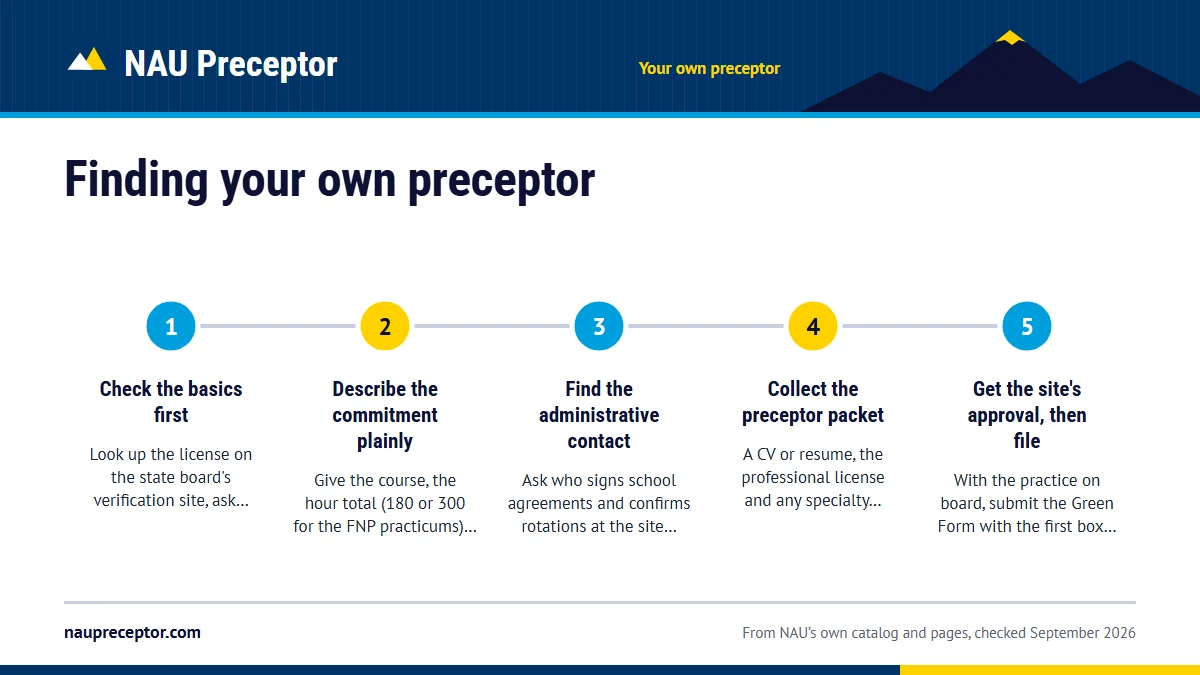
A short, organized first conversation saves weeks later. Work through these in order before you file anything with NAU.
- Check the basics firstLook up the license on the state board's verification site, ask how long they have practiced as an NP or physician, and confirm their certification matches your track.
- Describe the commitment plainlyGive the course, the hour total (180 or 300 for the FNP practicums) and the term dates, and explain that clinical days on weekends, holidays or breaks require advance sign-off from the FNP Program Coordinator.
- Find the administrative contactAsk who signs school agreements and confirms rotations at the site, and note that person's name and title for the form.
- Collect the preceptor packetA CV or resume, the professional license and any specialty certification, ready to go when NAU asks for them.
- Get the site's approval, then fileWith the practice on board, submit the Green Form with the first box checked, well before the term's cutoff.
What happens once NAU has your preceptor's name
From there NAU takes over the formal steps. The Clinical Placement Coordinator confirms the rotation with the site, a contract with the agency is opened if NAU lacks one, the preceptor's credentials are reviewed and the FNP Program Coordinator decides. You will be told when you may begin. The placement process page sets out each stage and its timing.
Stay in touch with your preceptor while the paperwork moves, so the days you discussed stay open; a practice that hears nothing for weeks may give the slot to another student. If NAU turns a candidate down, ask which requirement fell short and screen your next lead against it. A shortlist of two or three qualified preceptors in your area is worth more than one perfect name.
Why NAU students choose us to do the finding
Finding the preceptor is the part of NAU's process that lands on you, and it is precisely the part our placement desk takes on. We scout preceptors and clinics that suit your practicum and sit close to where you live: family practices that see every age, including children and women's health visits, for the FNP track, and psychiatric clinics or units for the PMHNP track.
Before a name ever reaches you, we have checked it against R4-19-502 as NAU reads it, identified the site's administrative contact, gathered the CV, license and certification, and secured the practice's yes, so the Green Form you submit already has the site's yes behind it, weeks ahead of the cutoff. Every FNP practicum gets planned at once, and our team stays reachable all term in case a preceptor bows out. Start with the contact form.
Questions NAU students ask
Do I have to find my own preceptor at NAU?
The 2022-23 FNP guidelines encourage it rather than demand it. You can suggest a preceptor you have arranged, name a site you want and ask NAU for help requesting it, or accept a placement NAU offers. Whichever route you take, the FNP Program Coordinator signs off on the preceptor and owns the final placement call.
Can a physician be my preceptor at NAU?
Yes, if they meet the Arizona rule NAU follows: a clean, current medical license in their own state of practice, twelve months or more in clinical practice, and a patient population comparable to your program's. The older Green Form listed MD and DO as credential options alongside FNP. The certification requirement in the rule is written for nurse preceptors.
Can my preceptor practice outside Arizona?
The license test in NAU's rule looks to the state where the preceptor practices, so it allows for preceptors elsewhere. NAU has not published a rule on graduate clinicals outside Arizona, and some states set conditions of their own for out-of-state students. Ask your program coordinator before you commit, and read our state authorization guide.
Should I phone a hospital unit directly to ask for an NP preceptor?
For the big systems, usually not. The student pages of Banner and Valleywise ask students to leave preceptor requests to the school rather than phoning around, and HonorHealth, Dignity Health and Northern Arizona Healthcare route requests through the school. List the site on your Green Form and ask NAU to make the request. Independent clinics differ: calling them yourself is often the quickest route.
What if NAU does not approve the preceptor I found?
The FNP Program Coordinator's decision stands, so move quickly. Find out which requirement the candidate missed, whether license, experience, focus, certification or setting, and use it to screen your next lead. A second qualified name in reserve protects your cutoff date. If time is short, our urgent placement page explains how we work against a close deadline.
Related pages
Last checked 2026-09-27
We check these pages against Northern Arizona University's own catalog, program pages and published nursing documents. Your program coordinator and course faculty have the final word.
NAU welcomes a preceptor you arrange. We arrange one close to home.
Tell us your NAU track, your town and your next practicum. We line up preceptors who fit the course and Arizona's preceptor rule, confirm the site's approval, and gather the CV, license and certification the Green Form needs, well before NAU's cutoff.
- Preceptors matched to the course: all-ages family primary care for FNP, psychiatric settings for PMHNP
- License, experience and certification checked against the rule NAU applies, before the Green Form goes in
- All three FNP practicums planned together, near home instead of a long drive away
Start your placement plan
Track, town and next practicum is all we need to begin.