The recommended FNP hour mix at NAU
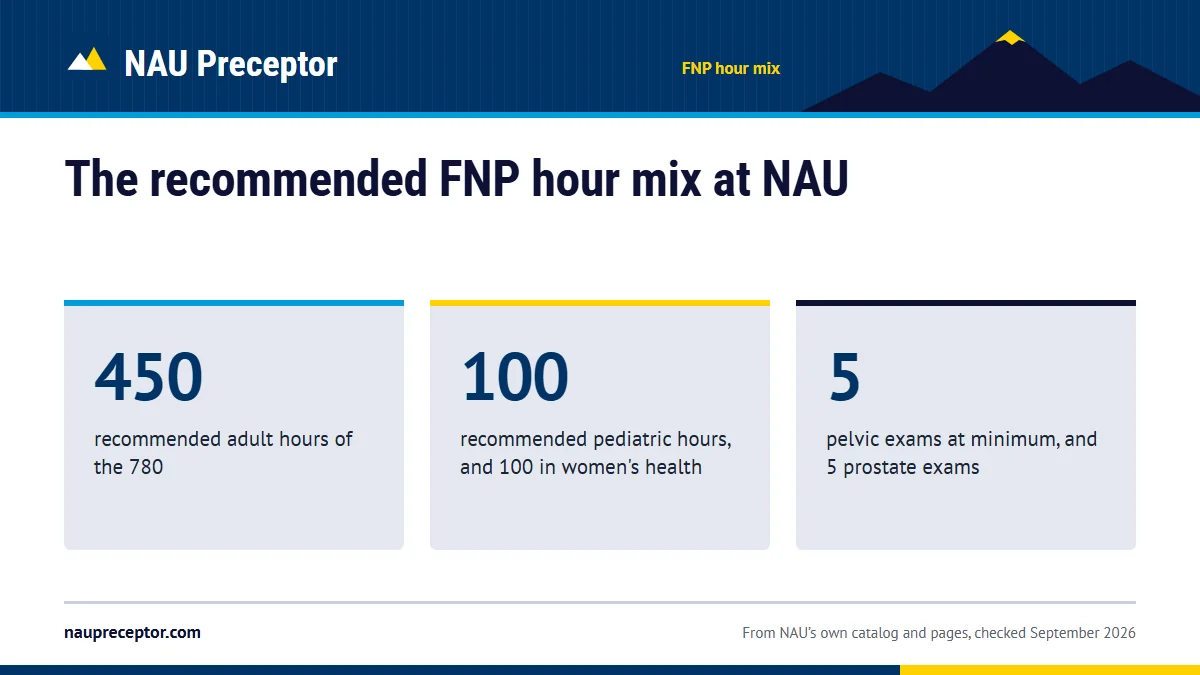
NAU's 2022-23 FNP Clinical Guidelines recommend spreading the 780 clinical hours as about 100 pediatric, 450 adult, 100 women's health and 75 to 150 specialty hours, and they set minimum counts for certain visits, such as 5 pelvic and 5 prostate exams. The split covers the whole program rather than any one course, and it decides which preceptors you need in which term.
Build your hour mix
Tell us which practicum you are in and what your log shows. We find preceptors for the hours still missing.
The split, in NAU's numbers
The guidelines give each category an hour figure and, for three of them, a percentage. Here is the spread as NAU printed it, with the arithmetic beside it.
| Category | Hours | NAU's percentage | Share of 780 (our arithmetic) |
|---|---|---|---|
| Pediatric | 100 | 15% | About 13% |
| Adult | 450 | 55% | About 58% |
| Women's health | 100 | 15% | About 13% |
| Specialty | 75 to 150 | Not given | About 10 to 19% |
| Total | 780 |
The hour figures and the percentages do not match exactly. The three fixed categories add up to 650, which leaves 130 hours for specialty time, inside the 75 to 150 band. Treat the hour figures as your working targets, and if a course's expectations ever read differently, ask faculty which one they grade against.
Visit minimums sit alongside the hours
Beyond the hour spread, the 2022-23 guidelines set minimum counts for particular visit types. Two of them are 5 pelvic exams and 5 prostate exams, and the guidelines list others; the version your course provides has the complete list, and course faculty can confirm whether any counts have changed since 2022-23.
Counts behave differently from hours. A busy adult practice can fill 300 hours in a term and still produce very few pelvic exams if women's care is referred elsewhere. Ask a prospective preceptor directly how often those visits happen in their clinic before you commit a practicum to them.
A site can give you all the hours you need and still leave you short on pelvic or prostate exams. Track the counts as closely as the hours.
Matching each category to the right preceptor
Every preceptor has to meet Arizona rule R4-19-502 as NAU applies it, and one line of that rule matters most for the mix: the preceptor must practice in a population focus comparable to the program's. For an FNP program that means family care across the lifespan.
- Adult hours are the easiest to find, since most family practices see adults every day.
- Pediatric hours come most smoothly from a family practice with a real pediatric panel. A pediatric-only preceptor may be possible, but whether that practice counts as comparable is the FNP Program Coordinator's decision.
- Women's health hours often need a deliberate block: a family practice that does its own well-woman care, or a women's health setting the coordinator accepts.
- Specialty hours are the most flexible band. Which specialties count is not spelled out in the archived guidelines, so clear the setting with faculty before you book it.
Adding a second site for pediatrics or women's health means a second approval and, if NAU has no agreement with that agency, a second affiliation agreement. Start those early. The full preceptor standard is on the requirements page.
Planning the mix across three practicums
Because the targets span the program, the easy mistake is to fill NUR 661 and NUR 663 with adult visits and leave all the pediatric and women's health time for the final term. One workable plan spreads each category across the year, as below.
| Practicum | Adult | Pediatric | Women's health | Specialty | Total |
|---|---|---|---|---|---|
NUR 661 (summer) | 120 | 40 | 20 | 0 | 180 |
NUR 663 (fall) | 200 | 30 | 40 | 30 | 300 |
NUR 665 (spring) | 130 | 30 | 40 | 100 | 300 |
| Program | 450 | 100 | 100 | 130 | 780 |
Your own numbers will depend on the preceptors you can get and the patients they see. The point is to leave NUR 665 with gaps small enough to close in one term, not a whole category to find from scratch in January.
Keeping the mix visible in your log
The mix only helps if you can see it. Record each encounter with the patient's age group and visit type, and total the categories at the end of every practicum rather than once in May. NAU's 2022-23 guidelines name Typhon as the tracking system, and later mentions name Exxat; the tracking guide covers both, and course faculty will show you how your cohort's system records visit types.
A running tally also gives you something concrete to bring to a preceptor. Telling a preceptor in week two that you still need, say, a dozen pediatric visits and three pelvic exams gets you better cases than asking for variety in general. The same tally helps if a preceptor leaves mid-term, because the next one can see at a glance what is still missing.
How we build the mix into your placements
We plan against the mix, not one preceptor at a time. Your placement advisor looks at the hours and visit counts each practicum needs to contribute, then finds family practices near home whose patient panels deliver them, adding a women's health or pediatric-heavy site where the main practice runs thin.
Each preceptor is checked against R4-19-502, including the comparable population focus question, before anything reaches NAU, and we gather the CV, license, certification and site approval for your Green Form. If a mid-program review shows a gap, we find the site that closes it in time for the next practicum. Students who come to us partway through the sequence start from the log they already have, and the plan covers only what remains.
Questions NAU students ask
Is the NAU FNP hour mix a requirement or a guideline?
The 2022-23 FNP Clinical Guidelines present the hour spread as a recommendation, while the visit counts are stated as minimums. How strictly each course applies them is up to course faculty, and the current guidelines come from your program coordinator, so ask at the start of NUR 661 how the mix is reviewed.
What if my practicum site sees almost no children?
You have two routes: shift pediatric time into another practicum with a better-suited preceptor, or add a second site for a pediatric block. A second site needs the FNP Program Coordinator's approval and an affiliation agreement if NAU has none with it, so decide early in the term, not in the final weeks.
Does the PMHNP track have a similar hour mix?
No PMHNP clinical handbook can be read publicly, so no PMHNP split is published. The catalog describes NUR 680 around psychiatric assessment, diagnosis, treatment planning and documentation. PMHNP students should ask their program coordinator whether age groups or settings are tracked; the NUR 680 guide covers what is known.
Where can I find the full list of FNP visit minimums?
In the FNP Clinical Guidelines your course provides. The 2022-23 edition survives as an archived copy and lists the counts, including the pelvic and prostate exam minimums. Because NAU no longer posts graduate handbooks publicly, course faculty or the FNP Program Coordinator can confirm whether any minimums have changed.
Related pages
Last checked 2026-09-27
We check these pages against Northern Arizona University's own catalog, program pages and published nursing documents. Your program coordinator and course faculty have the final word.
NAU welcomes a preceptor you arrange. We arrange one close to home.
Tell us your NAU track, your town and your next practicum. We line up preceptors who fit the course and Arizona's preceptor rule, confirm the site's approval, and gather the CV, license and certification the Green Form needs, well before NAU's cutoff.
- Preceptors matched to the course: all-ages family primary care for FNP, psychiatric settings for PMHNP
- License, experience and certification checked against the rule NAU applies, before the Green Form goes in
- All three FNP practicums planned together, near home instead of a long drive away
Start your placement plan
Track, town and next practicum is all we need to begin.